The decision-making trick I wish I’d learned sooner.
Why a tight deadline is the best decision-making tool I've added this year.
Sit a smart person in front of a list of 25 ways to raise a million dollars by the end of the year, and they'll spend the rest of the day deciding which ones to chase.
Tell that same person they have to raise ten million in six months, and the list collapses to three.
Two of them are the answer.
The other twenty-two were never the answer, they were just options. And options, it turns out, are not the friend we think they are.
How most of us decide
Most people I know, the good ones, make decisions through two filters.
Filter 1: Does this fit my values? You have a set of beliefs about who you are, what you're building, and who you'll work with. Decisions either pass through that filter or they don't. (And if you don't have a written set of values you actually use, that's a different newsletter, write some. Right after you finish organizing your garage and starting that podcast.)
Filter 2: Does this move me closer to my goals? Once a thing fits your values, you ask whether it's actually pulling you toward something specific. Otherwise you're just doing things that aren't bad, which is a polite way of describing a wasted decade.
That's the framework most thoughtful people run on. Values plus goals. It's a decent system. It will not embarrass you. It also probably won’t make you wealthy, dangerous, or particularly interesting.
But it's missing something. At least it was for me. I could always explain why an idea fit my values and my goals. What I couldn’t explain was why I still wasn’t moving as fast as I wanted.
The third filter
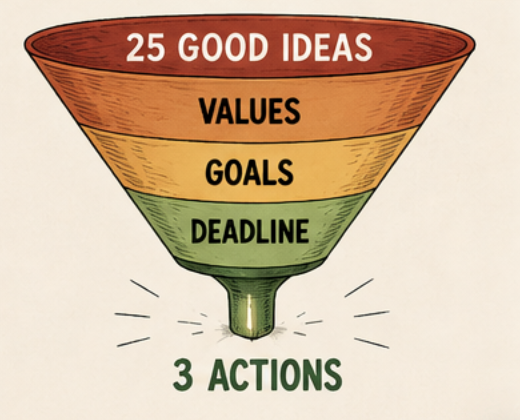
Benjamin Hardy's book Time Is a Tool gave me language for what I'd been feeling all spring. The two-filter model has a hidden assumption: that you have all the time in the world to accomplish your goals. And as long as that assumption holds, the framework keeps spitting out too many "yes" answers.
The third filter is the deadline.
By when?
Specifically: by when does the goal actually have to be done?
Add that filter and watch your option set collapse in real time. Most of the things that "could work" stop working the second you put a clock on them.
That is a feature, not a bug. Most of us don’t need more opportunities. We need fewer ways to procrastinate while feeling productive.
The receipt
Quick story.
When Scotty and I sat down with our consultant Neil in February, we set a goal to scale our lending company to $5M on the street by year-end. We have about $3M deployed today. That means raising another $500K per quarter, give or take, and we'd get there.
In that version of the goal, our options are practically unlimited. Pull a few investors at $100K-$500K each. Tap a few existing relationships. Get a couple of lines of credit against our owned properties. We'd stitch it together with three or four moves and call it a year. Lots of options. Lots of comfort.
Then we played a different game.
What if we made the goal $10M by year-end?
Suddenly the room got quiet. The kind of quiet that happens when a goal stops being motivational and starts becoming math.
$7M in seven months. Raising $25K at a time will not get you there. Stitching a couple of lines of credit against owned properties will not get you there.
You have to go to banks, and you have to go now. You have to find a family office. You have to bundle a fund. You have to do the work nobody enjoys doing because it's the only work that scales fast enough. Funny how the answer is always hiding behind the thing you’d rather postpone until next quarter.
The bigger goal didn't add options. It deleted them. And in deleting them, it told us exactly what to do for the next six months.
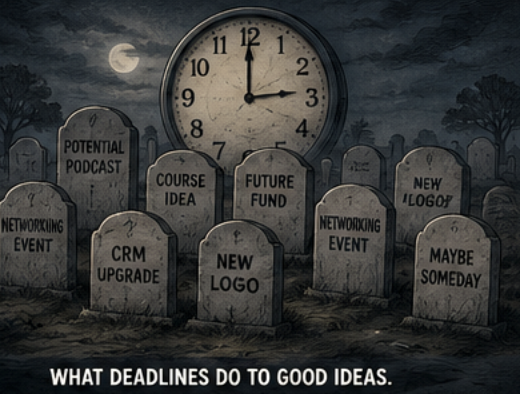
We're now actively talking to seven banks, already sitting with $1.2M in commitments and potential to get additional millions with these banks before year-end, and chasing the path the smaller goal would have hidden from us.
Why fewer options is the win
I’ve felt this repeatedly in my own life, and maybe you’ve experienced it too.
You walk into the Cheesecake Factory and the menu is a 41-page novella. You leave with a Caesar salad you didn't even really want and somehow still with a bill that looks like a mortgage payment.
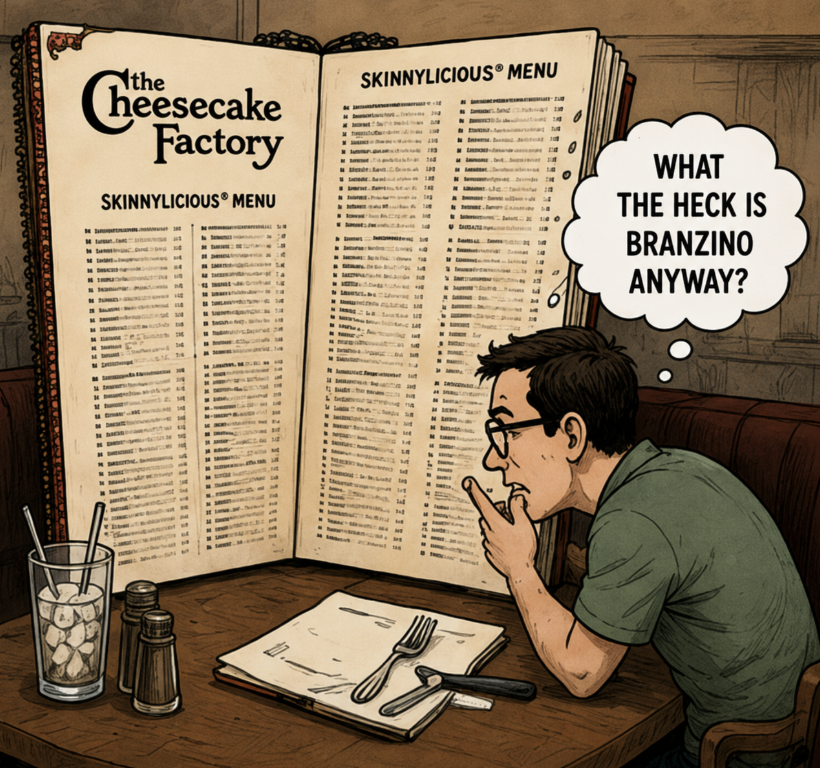
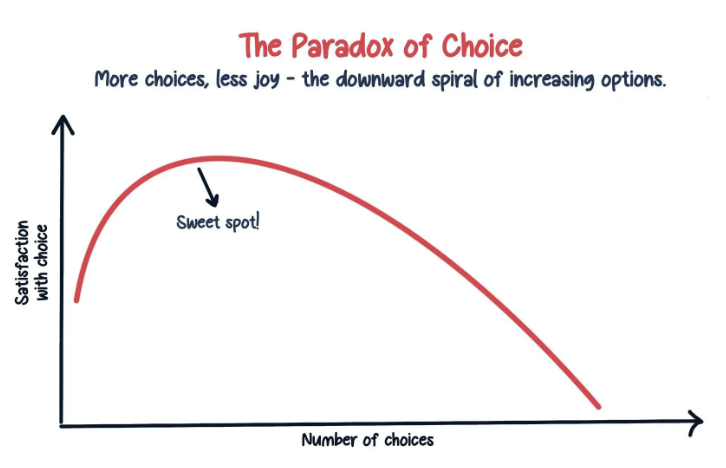
Psychologists call this the Paradox of Choice — too many options causes anxiety, paralysis, and worse decisions, not better ones.
There's a story from 1950s Los Angeles about a shoe salesman named Ben Prober who built one of the most successful retail operations of his era on a single rule: never give a customer three pairs to choose from.
A customer would try on two pairs. If they hesitated and asked to see another option, Prober would smile and ask, "Of course. And which of these two should I take away?"
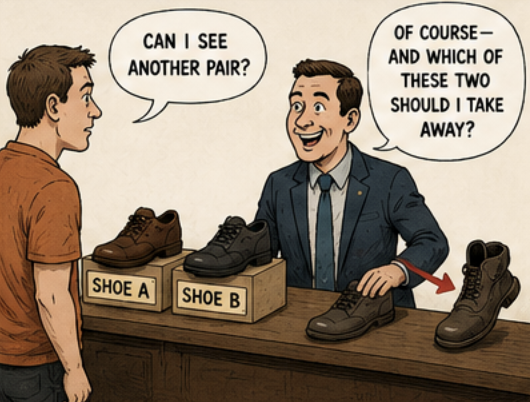
He didn't add a third pair. He swapped one out.
Two options is a decision. Three is a problem. Four is a customer who needs to "think about it" and never comes back.
Prober sold a lot of shoes. Apparently the greatest sales technique in history is removing choices from adults.
Now run that on your business.
When you have ten years to hit a goal, you have functionally infinite paths. So you sit at a 41-page menu, and you don't pick anything that requires real risk because you don't have to.
Cut the deadline in half. Then in half again. Watch what happens to the menu.
Make the deadlines shorter
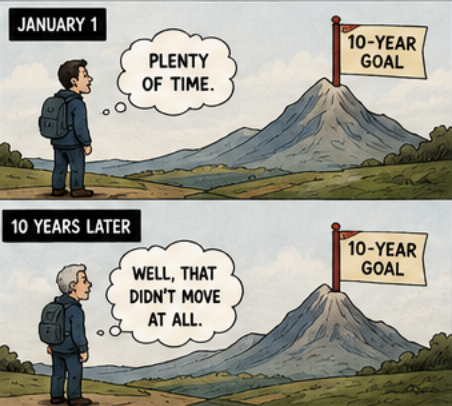
Hardy has a line in this book that punched me in the mouth: the 10-year goal is mostly performance art. What are you going to do today to accomplish your 10-year goal? Nothing. Absolutely nothing. That's 3,653 days from today.
So you do nothing today, and 3,652 more nothings, and on day 3,653 you blame the economy, the election, interest rates, Fluoride in the water, or whatever excuse is trending at the time. Make the deadlines shorter. Make them inconvenient. Make them ones where if you don't move this week, you're already behind.
The other reason short deadlines work is colder: work expands to fill the time allotted for it. A task you give two weeks takes two weeks, whether it could've been done in two days or two months. Parkinson's Law has been making fools of us since 1955.
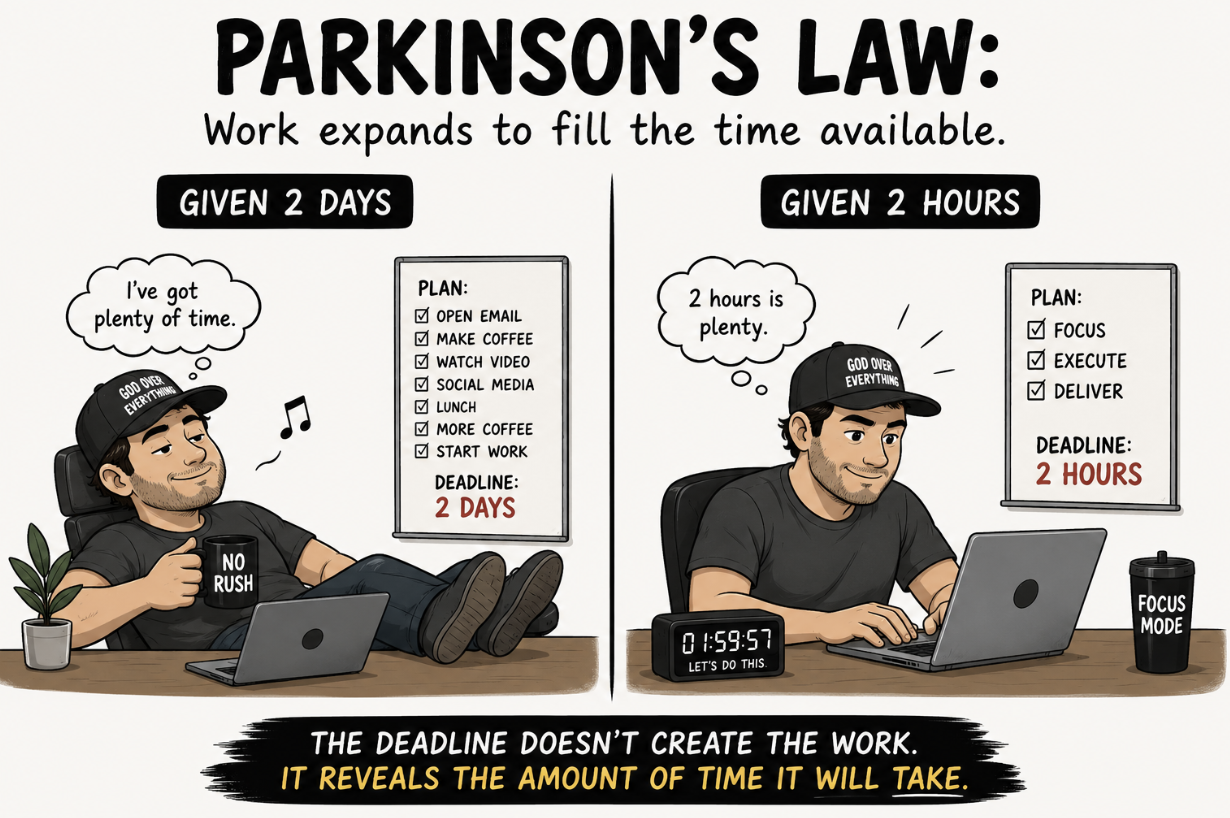
The move follows directly: take the deadline you think is "reasonable", the one your team will agree to without flinching, and cut it in half.
You will hit it. Not because you worked twice as hard, but because you decided faster, said no faster, and stopped renting mental real estate to the twenty-two paths that were never the answer.
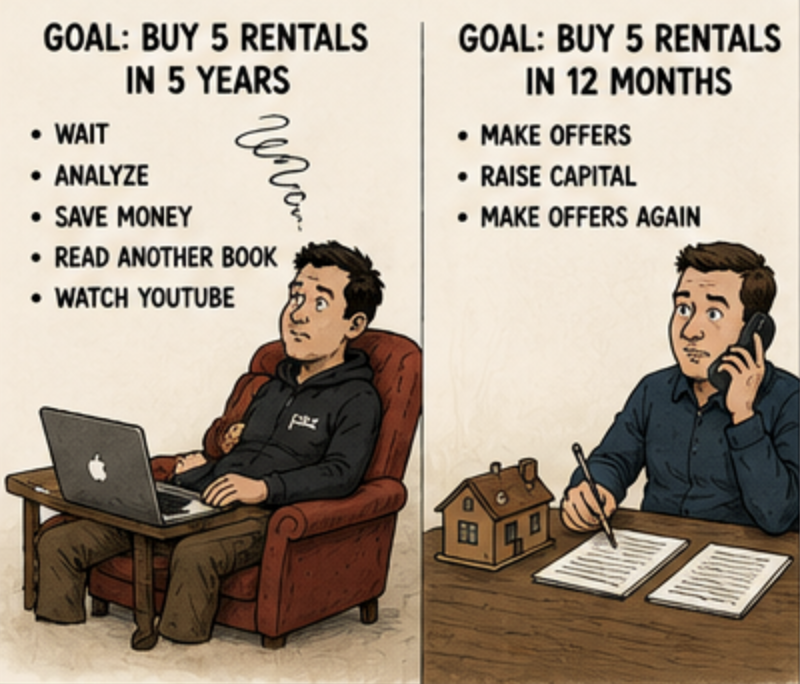
Putting it on steroids
A couple of months ago I wrote that clarity is the cheat code.
That's still true.
But once you have clarity, the way you put it on steroids is by setting deadlines that are uncomfortable. The kind that make Scotty stare at the ceiling for an extra minute before he agrees. (He always agrees. He's just running silent calculations on which of his current commitments has to die to make room.)
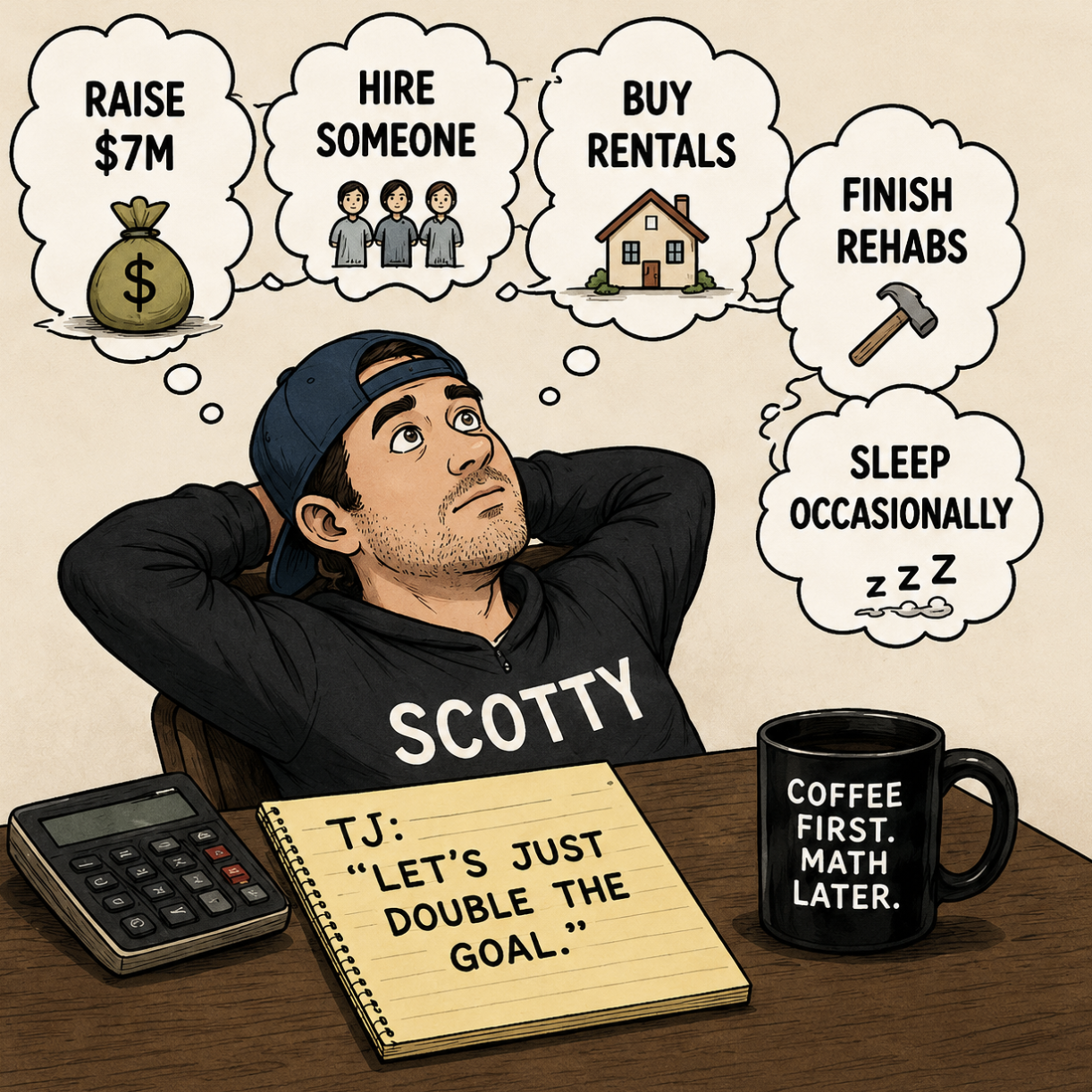
Your challenge
Pick your most important goal for this year.
Now cut the deadline in half.
Don't change the goal. Just the timeline.
Sit with the discomfort for a minute. Then write down the three things you would actually have to do, not the twenty-five you've been considering. The three.
That's your roadmap.
At least that’s what I’m learning. I’ve spent my entire life treating optionality like a superpower and pretending I was smart for always thinking of new ways my goals could be accomplished. More often than not, it was just an excuse to delay committing to the thing I already knew I needed to do.
— TJ Moe