What Does Your Tuesday Look Like in Five Years?
What Does Your Tuesday Look Like in Five Years?
I asked myself that question in Scottsdale
I (TJ) was in Scottsdale a couple of weeks ago at a mastermind with about twenty guys who are doing serious things in real estate and business. Big operators. The kind of room where someone casually mentions buying 900 apartment units and I try to pretend I hear that all the time.
We did a lot of good work. But one exercise has been stuck in my head all week, and it's the one I want to talk about today.
The facilitator stopped us mid-session and said: Close your eyes. It's Tuesday, March 24th, 2031. Walk me through your day.
Not your goals. Not your vision board. Your actual Tuesday. Specific. Detailed Live it.
Here's mine.
Tuesday, March 24, 2031. I'm 40 years old.
MY ANSWER — WRITTEN IN REAL TIME
I don't set an alarm. I wake up naturally around 5AM because that's just who I am, not because a contractor texted me at 4:47. My wife is next to me. We're in our house on five acres. My parents live next door, which was the plan all along and we actually pulled it off. My grandparents lived with us for a couple of years when I was a kid and they were some of the most fun of my life. I want to give that to my kids too.
I do my morning devotions and Bible reading and start the day spending time with God. I work out at 6. Not alone. I've built a community around early morning training with close friends, people I've invested in, people who push me. It's one of the best parts of my day.
I come home to chaos, on purpose. Four kids (for now, six if I can convince Kara). Kara is homeschooling them. I sit down for breakfast with the family and I'm actually present. Not answering emails, not running numbers in my head, and not thinking about a closing. I pour into them before my workday starts. This is protected time.
My workday is unrecognizable from today. I'm not reviewing invoices. I'm not listing houses. I’m not walking properties. I'm not doing punch lists. I'm raising capital for big projects, getting in rooms with people doing exceptional things, and casting vision for what we're building next. My businesses run without me in the day-to-day. The systems and the people are that good.
In the winters, we leave. We will go somewhere warm for a few months. Because we can and because geography is freedom too.
I own $50M in real estate. I give outrageously — to the church, to people I see with needs, to things that are bigger than us. The money is a tool, not a scoreboard.
I work because I want to and I enjoy it and I love building things, not because we need the active income. My kids and the people around me I value most get the best version of me every day.
I wrote that in about three minutes. And then I sat with it for a minute and thought: A lot of things have to change to get me there.
The question isn't whether that Tuesday is possible. The question is: what's standing between me and it? And how fast can I remove those things?
Five years is an eternity. Two years is not.
Here's where it got uncomfortable. The facilitator pushed us: What if you didn't have five years? What if you only had two?
Elon Musk was recently asked how he moves so quickly on his projects. He had two answers. First, you have to have a maniacal sense of urgency, which is actually an understatement given the pace that he’s able to execute. Second, you always have to be addressing the limiting factors that are preventing you from growing and moving fast. What is slowing the machine down? Kill it. What is blocking the path? Eliminate it. He doesn't 10x by doing more of the same things faster. He’s able to 10x by fundamentally changing what the machine is doing.
That reframing matters. Because most of us, and I include myself, think about growth as an additive equation. Do more. Hustle harder. Work longer. Grind it out until the numbers catch up.
But there's a book I read a couple months ago that broke this open for me, and I keep coming back to it.
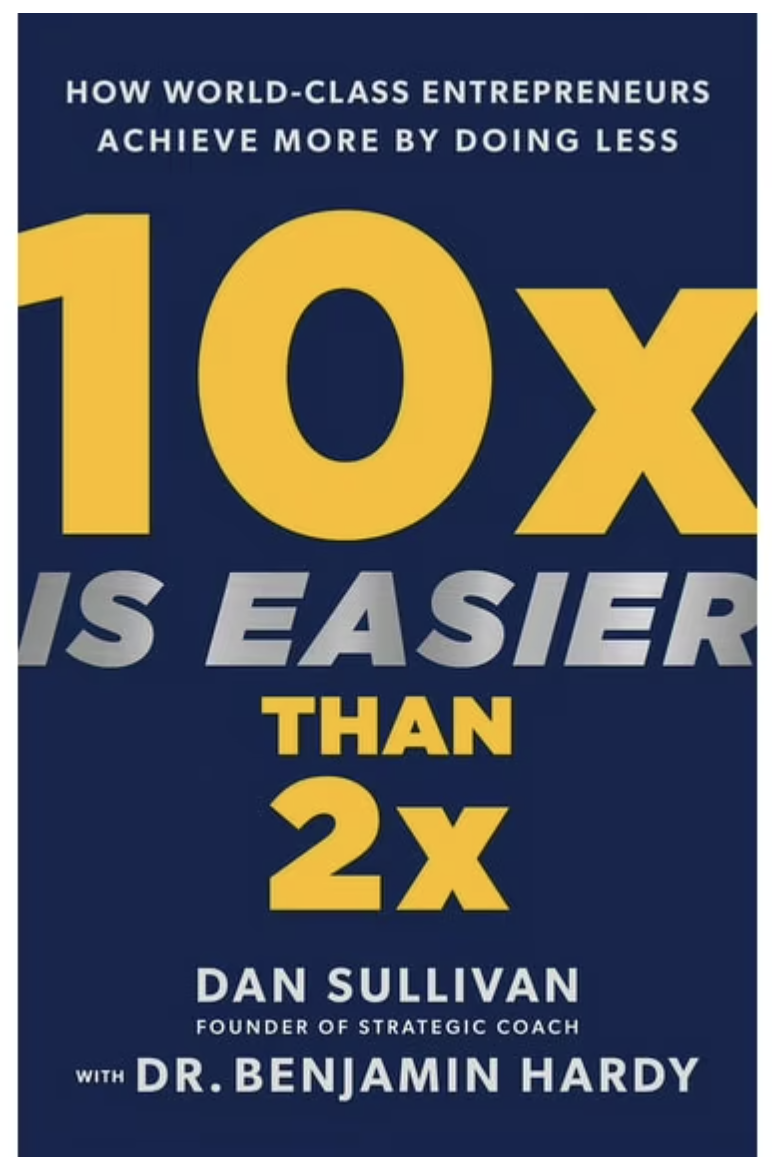
10x Is Easier Than 2x.
Dan Sullivan (the actual brains of this idea) and Benjamin Hardy wrote a book called10x Is Easier Than 2x and the premise sounds insane until you think about it for thirty seconds.
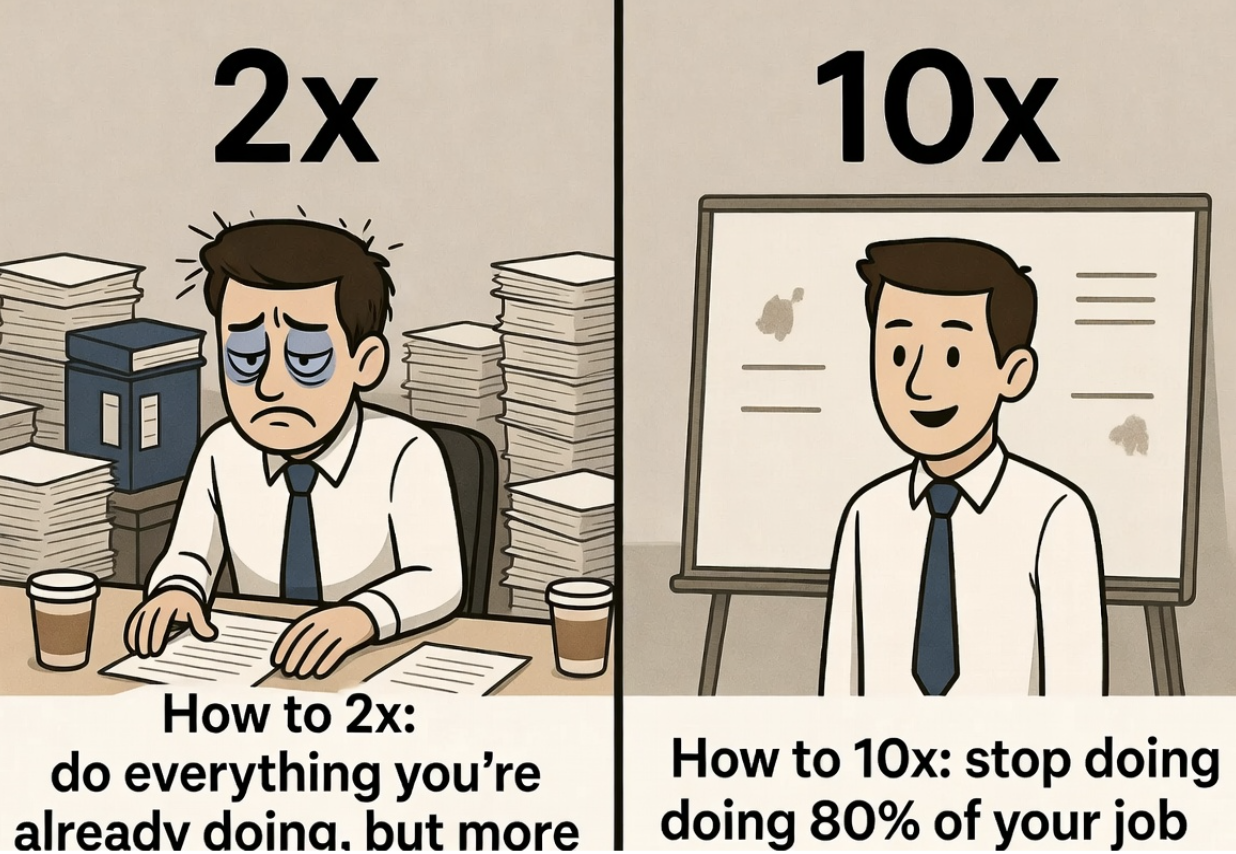
To double your income, you have to roughly double your effort. More deals, more hours, more of the same things you've already been doing, just more of it. And that's exhausting. Most people attempt it, burn out, and conclude that growth is just hard.
But to 10x your income? You cannot 10x your effort. There aren't enough hours. So something else has to happen. The math forces a different answer.
That answer is the Pareto Principle, taken to the extreme.
The Pareto Principle states that 20% of your work produces 80% of your results. Many people know this and ignore it, because eliminating the other 80% feels risky. What if I need that stuff? What if it matters more than I think?
It doesn't. Here's how to think about it:
Find the 20% producing 80% of your results. Then find the 20% of that 20%. Then the 20% of that. Do more of that, and ruthlessly stop doing everything else.
The only way to 10x is to stop doing most of the things that got you to where you are today. You have to try entirely new things. Different asset classes. Different team structures. Different use of your time. Different conversations. Different social circle. The path to 10x doesn't look anything like the path you're already on because if it did, you'd already be there.
So what does that mean for us?
It means we're done trying to grow by doing more of the same things. The businesses that got us to 76 rentals, 100+ flips, and $3M deployed in lending are good businesses. We're proud of them. But they're not the path to the Tuesday I described above.
The path to that Tuesday requires me to stop doing the things that anyone else could do, and start doing only the things that only I can do. Raising capital. Casting vision. Building a brand. Strategizing. Getting in the right rooms. Building the right team so the machine runs without me. Pushing our team to move faster than feels comfortable. That's the 20%. Then I begin searching for the 20% of that 20%.
For Scotty, it's the same exercise. His genius is in building systems and running operations and coming up with innovative solutions that produce unprecedented results. But right now he's buried under the weight of day-to-day tasks and decisions that shouldn't require him at all. We're fixing that — with a Head of Operations that we plan to hire very soon — so he can operate at the level he's actually built for.
And the growth lever we're pulling hardest right now? Short-term rentals. We have one in operation already. We’re working on three others as I type this. Instead of tip-toeing into that season, we need to move at a sprint pace and figuring it out on the run.
The lending business scales in parallel. We have demand we can't meet because we don't have enough capital, but we’re actively raising it and have some really good opportunities. If you’re interested in returns secured by real estate, that's a conversation worth having.
We’re investing in and betting on ourselves. We hired a business coach. I joined a mastermind with high level executors. We’re building a team that can support the vision. We’re thinking bigger. We’re refusing to be afraid of losing what we have in order to gain what we want (more on that in the next newsletter).
None of this is magic. It's just clarity on the Tuesday we're building toward, on the things we need to stop doing, and on the 20% that actually gets us there.
I'd challenge you to do the same exercise. Close your eyes. It's a Tuesday in five years. Walk me through your day.
Then figure out how to get there in two.
— TJ Moe